Tuesday, February 27, 2007

Rat-a-Tattoo

I've never wanted a tatoo before, but Carlos almost makes me want to get one. Maybe it's because he got a tatoo I really identify with, or perhaps it is because his tatoo is such a wonderful affirmation to me. Maybe because he is the only Aruban in the world with Jesus Christ tatoooed in Welsh on his forearm, and I feel like I should get some Welsh tats. Maybe I'm simply becoming more of a rebel, and I've decided it's time for the revolution to begin.

There is something to be said for creating a tribal identification with life changing groups, and experiences. That is what Carlos did with the Celtic Cross up on the wall of The Vault.

Carlos got the tatoo, because he identified with the mission and message of The Gathering, and has been experiencing some signifacnt change in his relationship with God. The tatoo was like a rite of passage, and it has a tribal indentification.

see Carlos' Tatoo here.

Wednesday, February 21, 2007

The Nervous Rebel

So, I've got this conference we will be promoting fast and furious real soon. In about 70 days, we've got a big show to put on, and we've got friends, and fames travelling from other places to speak, and the conference is another pushing the edges kind of thing. We've named it "God for People Who Hate Church." Some people love the name and the idea of the conference, others are freaked by the word "hate."

As a new endeavor, and something bigger than we've done before I am quite nervous. As an event which challenges the way, and the spirit in which we do church, I am happy to be a part of it, and all the more nervous as well. As someone who typically hates Christian conferences - for leaders especially (because they never treat leaders like leaders - they only set up talking heads, and ignore people who might have far more to say), I am fearful of setting up another silly talking heads event - oh Lord save me from that - Please!

So once again, as has been the model of my life - I am the nervous rebel.

Saturday, February 10, 2007

How Heretical I Really Am!

Okay, I took another one of those inaccurate online tests, and it is supposed to tell me if I am a heretic. Maybe this one isn't so bad. Fist it says I'm not really a heretic. Second, it says that the heretic I am closest to is Pelagius. Woo-hoo! I am like a Welsh heretic who sought to define freedom for Christianity. Okay, that's kind of cool.

So here's the test results:

You scored as Chalcedon compliant. You are Chalcedon compliant. Congratulations, you're not a heretic. You believe that Jesus is truly God and truly man and like us in every respect, apart from sin. Officially approved in 451.

Chalcedon compliant

83%

Pelagianism

58%

Nestorianism

50%

Monophysitism

50%

Donatism

25%

Apollanarian

25%

Modalism

8%

Monarchianism

8%

Adoptionist

0%

Arianism

0%

Gnosticism

0%

Albigensianism

0%

Socinianism

0%

Docetism

0%

Are you a heretic?
created with QuizFarm.com

Friday, February 02, 2007

Apologies at JohnSmulo.com

Occasionally a blog post will significantly stop me, and make me ponder deeper things in life. This simple post about an apology on John Smulo's blog is mundanely profound, and stopped me for about 10 minutes this morning.

Please read it. It is short. But then be sure to comment in a manner specifically significant to your own life.

I have discovered the power of the apology can be life changing.

Saturday, January 27, 2007

Redefining Heresy (Part 2): Augustine Sets the Standard

A quintessential pursuit of heresy occurred in the 4th and 5th century. Today those old battle lines are discussed and dissected from seminary pulpits. The heretic has few writings, not because he did not write, but because they were destroyed by his detractors. The hero on the other hand is still commonly quoted, and republished today. All we know of the heretic is his name, a little history, perhaps a few brief writings, and his effective defenses against the accusations.

His name is defamed as a great heretic in Christian history, but not because we know what he taught, but because of who accused him, and what they said about what he taught.

Augustine is remembered as the hero, and Pelagius the heretic, and the methods of the pursuit of a heretic has been outlined for us down through the ages on the basis if this story.

Pelagius came from Britain (perhaps from Wales) to Rome, and saw rampant immorality, and even a laxity of morality in the Roman church. He came as a moralist. He perceived the teachings of Augustine on the nature of sin and grace to be detrimental toward encouraging holiness. At some point in the interactions Augustine responded by accusing Pelagius of heresy, and with his influence, and that of others had Pelagius brought before councils on heresy charges. Over the years, two ecclesiastical synods, two popes, as many as thirty-two bishops and many influential Christians found nothing wrong with Pelagius' teachings.

There is evidence that many of the anti-pelagian writings of the church fathers quote Pelagius and make a variety of arguments against points which it is unlikely that Pelagius intended.

Jerome refers to Pelagius as "the huge bloated Alpine dog" who must be "battered with the club of the spirit."

Even after being exonerated many times, Augustine, Jerome, and others kept pursuing some final verdict of Heresy.

Was Pelagius a heretic, or simply a reformer who considered the teachings of the more influential Augustine to be detrimental to a practical life of holiness, and thereby was aggressively pursued unjustly? We can not be sure, but this we do know: He was not pursued on his lifestyle, because Augustine remarked on his piety. He could never really be clearly pinned down on teaching heresy, and that is why he was repeatedly exonerated.

Could it be that the accusations which fly today, often for misunderstanding, and exaggeration, and mixed with name calling are justified in the early church fathers, who potentially used similar fallacies of logic to name the heretics in their day?

We can not be sure, yet we still name the heretic by defining his beliefs through other's words, and we name the defender of the faith by listening to what he says about himself, and what his friends have to say about him. It seems to me that things have not changed, and they may not until disagreeing parties can learn to sit down with one another, and talk, and listen, and truly understand what each other are saying.

Who's the heretic? The one who teaches something misunderstood, or the one who accuses the teacher, maybe even falsely?

Aberrant Christianity is an issue of unethical behavior, as much as it is an issue of strange doctrine. One can not separate the two, yet the pursuit of Pelagius appears to do just that.

I have seen accusers get away with unethical behavior, and be rewarded for it. Is this the fruit of 2,000 years of heresy hunting? I should hope not.

Monday, January 22, 2007

Redefining Heresy (Part 1)


"For the grace of God that brings salvation has appeared to all men, teaching us that, denying ungodliness and worldly lusts, we should live soberly, righteously, and godly in the present age, looking for the blessed hope and glorious appearing of our great God and Savior Jesus Christ, who gave Himself for us, that He might redeem us from every lawless deed and purify for Himself His own special people, zealous for good works." (Titus 2:11-14)

A typical evangelical approach to orthodox teaching, and its antithesis - heresy, is a completely intellectual issue. A heretic is someone who believes, and teaches something different than the accepted orthodox positions.

Very early in the Christian Church this became the primary means of identifying heretics, and separating them from the church - thanks to such people as Augustine, who relentlessly pursued Pelagius - perhaps even to the death.

The writings of John have become sources for this position. John tells a house church in his second epistle to avoid inviting heretical teachers into the home. These heretical teachers rejected the teaching that Christ came "in the flesh."

Paul likewise warns the church about teachers bringing rules about keeping the law, and sporting a doctrine of salvation through obedience to the Mosaic covenant.

Yet this approach toward defining heretics is far too simplistic, and potentially detrimental to the life of the church. In the passage written to Titus by Paul we discover that the teaching concerning Jesus is a teaching which is connected to our behavior. It is tied to denying lusts, and ungodliness.

I have heard of people who were called into account for supposed false teaching, but when was the last time someone was called a heretic for something other than an issue of teaching falsely? If someone who denies that Jesus came in the flesh is a heretic, what is a Christian leader who lies, and destroys the ministries of other people for his own selfish gain? Is he not someone who is living out his "worldly lusts" and denying the "grace of God which brings salvation"? I would say yes, and I would also say that I know such people. I would say that I know Christian leaders who honor such people.

How did we get to the place where the guy with big church is the hero, even if he has harmed others to get there? How is it that he is not the heretic?

I am fan of sound teaching, but I find that I am becoming more of a fan of sound living. Those who teach mercy and mercilessly walk over others to get what they want, are heretics of the worse kind, and instead of being celebrated, ought to be rejected, and kicked out of leadership in the house of God.

Saturday, January 20, 2007

Somewhere Else


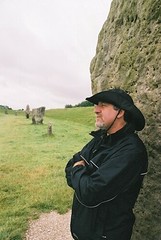
Avebury - Phil by the Stone
Originally uploaded by philkwyman.
Have you ever just felt like being somewhere else? This shot of me at Avebury reminds of a somehwere else I rather be right now. I don't often feel that way, because I love where I live, but the old denominational group, just sent another lie via snail mail, and I'd rather be somewhere else.

"Why do the wicked prosper?" I ask myself.

Of course, Webb reminded me the other day when we got together, when these things happen I understand why "the heathen rage."

My real reason for making this post was I wanted to get this photo on my profile, but Blogger has this really stupid process to get it from your computer to your profile.

What the heck is up with that!?

Friday, January 19, 2007

Oh, Mighty Nazarene Atlas!

I read stories of my hero the Nazarene Heretic, and I look for reasons for His behavior. I question why He treated some people more harshly than others, and why He treated some with the gentleness typically shared between lovers.

I have seen Him berate respected religious leaders for lying, stealing, creating followers whose destiny was Hell, and being motivated by Satan himself. Yet He carefully, and lovingly delivered an adulteress from public humiliation, and the threat of the law's punishment. What makes a man behave in such a manner?

The Nazarene saw something we do not, and its weighty concern bore upon him like the mythic Atlas carrying the world upon his shoulders.

Religious men stood between God, and the people God loved. Could it be that we still do this today?

Oh, Mighty Nazarene Atlas! I kneel before Your wisdom, and tremble before Your anger.

Tuesday, January 16, 2007

Ministering Like Jesus - with the Help of Demons?!

I was speaking at a friend's church in the Seattle area - Saturday night and Sunday morning. Saturday night was a primer on Neo-Paganism in America, and a little bit about our story in Salem Massachusetts.

On Saturday Night I told the story of our Halloween Outreach, and the tents of ministering Christians who offer "Psalm Readings," Dream Interpretation, and counsel people who sometimes wait in line for up to an hour. I described the people who make up this wildly divergent group categorized as Neo-Pagans. The Wiccans, Witches, Druids, Shaman, and assorted Pagan groups were loosely defined, and the incredible urban myths which grew out of the 1980's with the fear mongering-created by the likes of Mike Warnke was challenged.

A number of the people sat on the edge of their seats, and were deeply interested in a subject relevant to their children, and their children's friends at school. Their own kids were perhaps the most captivated by the teaching.

We entered a time of discussion and questions. Some people had questions which helped them further define this group called Neo-Pagans. Others were thankful for the teaching, and described people they knew who fit this people group called Neo-Pagans.

From the back of the room, a couple people had been stirring, and they came forward with some accusing questions about my allegiance to Jesus. Soon one lady, who was new to the fellowship began to describe the evil spirit I brought into the room, and said that if the leadership did not reject me fully, and throw me out, she would leave the church.

I sat down and gave her the platform, and established a dialogue with her. Some people sided with me, and others were now not sure what to think. One man began to side with her, under the belief that doing a "Psalm Reading" was a kind of compromising syncretistic action which would lead other Christians astray.

The evening did not end with any resolution in respect to this woman's concern that I was demonized, and bringing evil spirits into the church. She did not dialogue with those of us who were willing to talk through the issues, instead her pontificating remained a condemnation of my spiritual state, with no evidence but a subjective discernment of evil spirits filling the room, and swarming like gnats on a hot summer day all around me.

The following morning I spoke again, and this time I gave a simple testimony of my salvation, followed by how that experience influenced by missiology (although I did not use the word missiology for sake of keeping it simple.) My new-found buddy Jim Henderson from Off the Map was there.

He had a sense of the previous evening's difficulty, and grinned graciously, and understandingly in the back of the room. After the service, the youth and their parents gathered around to tell me how much the teachings had meant to them.

Later that day I was leaving for the airport to come home, and a young man who was a friend of the Pastor's son came out to tell me that he had understood Jesus for the first time during my teaching on Neo-Paganism the night before. He now wanted to be a follower of this Jesus.

I'm not sure which part of this surprised me the most: the lady who assumed I had devil's with me when I came to the church, or the kid who found Jesus in a primer for Christians on the subject of Neo-Paganism.

Is this how Jesus felt? He did good, and was accused simultaneously of doing his work under the power and influence of devils. I would enjoy following in the footsteps of Jesus the Heretic, and working under the power of the same Spirit.

These are the ongoing stories of previous experiences from the last two years. As I prepare a proposal to put our story onto the printed page, your input is deeply appreciated.

Sunday, January 14, 2007

My Favorite Heretic


heretic - n. a person who holds unorthodox opinions in any field (not merely religion)
recusant, nonconformist - someone who refuses to conform to established standards of conduct

or·tho·dox - adj. 1. Adhering to the accepted or traditional and established faith, especially in religion.

If you have not quickly guessed who my favorite heretic is even before I tell you, I will be surprised. The above quotes give clear indication of the life of the individual I respect most for his heretical ways. Human history has yet to to find a man or woman who would give their life so fully to teach concepts contrary to the established powers as this man did. Without concern for himself, he helped the broken, the suffering, the weak, and the young in spite of pressure to conform to the religious system of his time. When challenged by a hastily gathered court, trumped up with false charges, he refused to bow to conventional wisdom, and suffered a horrible death at the hands of corrupt religious powers.

He lived as a servant to humanity, and died an ignoble death as a heretic.

I generally capitalize not only his name as is standard for all names, but each noun and pronoun which refers to him. I have not done so to this point so you would have to wait, if you hadn't figured out who He was.

My favorite Heretic is the Nazarene.

I regularly read His life story to discover the people He came to serve. They were not the elite. They were not the rulers, nor the rich. They were not people of success, nor people of pedigree. He looked for the lost, and wore the servant's apron for the working class, and their children.

He was expected to serve the leadership, and the rulers of His day. That is generally the path to success, but He chose the path to sorrow and difficulty. His nose was not browned by being warmed at the back end of the powerful. When they were wrong, He stated so with the boldness normally reserved for judges speaking to criminals.

I have considered the people whom the Nazarene defended. They were not the churchgoing, nor were they considered the good citizens. They were the sinful, and the broken. They were people who were rejected by religion, and isolated by their circumstances from the rest of society.

Today, religious people often defend the church, and disassociate themselves from the broken, the strange, and the rebels. The Nazarene came for the these, spent time with the strange, and became a Rebel Who trained the next generation of rebels.

His interaction with the rich consisted of challenges of their allegiance to money's cruel, and powerful grip over their hearts. He spoke of the dangerous position of being rich, and the necessity of being willing to loose it all for the sake of living right.

He responded to the religious authorities with strong words of condemnation for their treatment of those they were supposed to be leading. He openly challenged them before the public - even on their own turf.

And so it was that my favorite Heretic ended up in a rigged trial, which condemned Him to that ignoble death.

I am convinced that He would be as much a Heretic today as He was then, and so I am not afraid to walk in His example.

I can embrace my inner heretic, because I have embraced my favorite Heretic

Thursday, January 11, 2007

Embracing My Inner Heretic


Some time back I took an internet test. You've probably done some of those same worthless tests which tell you silly things like how much your life is worth, or rate your personality by Sesame Street Characters.

This test told which famous minister I was most like. It said that I was like Martin Luther. Now I am sure that its margin of error is about 78%, so I'm not banking on starting a reformation anytime soon, but he and I do share the same birthday, and he was famous for doing something on Halloween. Although his 95 theses nailed to the door at Wittenburg are historically a little more important than our large Halloween outreach. But perhaps we have more in common.

He was treated as a heretic.

Wow. We've got three things in common. I'm feeling a reformation coming on after all.

I've decided it is time to embrace my inner Martin Luther. Yes, deep inside of me I have a rebellious, anti-institutional, break free from the bondage of legalistic religion trouble maker. I have an inner heretic.

My inner heretic has decided that truth matters, and keeping up appearances is only as good as the paper you wipe it with. Faithfulness to friends matters, and faithfulness to a program, or an institution will be scraped off the bottom of my shoe before I enter the house. Serving people is a non-negotiable item, and making sure selfish leaders get what they want needs a bag when I take my dogs for a walk. My inner heretic believes that all people are equal, and those who think they are more important can watch their ideals swirl down the porcelain pot.

My inner heretic has decided to rise up and live life fully. No more fearfully hiding from the hard face of tradition, or squinting under the harsh, questioning light of convention. I will not be like everybody else simply to make some self-serving, brown-noser happy.

If you can't tell what I think of bowing to abusive religion by now, I'm not going to spell it out because I can't say it on prime time TV.

There were times when the Apostle Paul got mad, though I have a feeling that it might have been more often than was warranted. Yet, I am deeply impressed by his gutsy response to the Senior Apostle Peter. Paul stood up against him, when Peter refused to eat with the Gentiles while the Jews were around. Peter kept the legalistic conventions of the day, and by doing so perpetuated a false sense of the spiritual superiority of one group over another. Paul's inner heretic rose up, and let Peter have it publicly.

Paul embraced his inner heretic and rose up to meet the troubles of the day. He broke away from the expectations of his peers, and stood against the tide of popular opinion, and the slowly simmering corruption which comes from doing things just because that's the way it's always been done.

Jesus showed some red face too. The tables of the temple's outer court flew, and the turtle doves were squeaking and fluttering all about, as the sheep and goats bleated, and nervously scampered for places to hide in the flying coinage and billowing dust. At first the "money changers" as they were called, were surprised, but you know they got angry and filed formal complaints. Jesus' inner heretic could care less, because His Father's house had become a den of thieves through exhorbitant prices, and an unfair money exchange.

I know who the real heretics were. They were individuals who received the wrath of the angry followers of the Father in Heaven, but as is often the case, this world turns things upside down. Truth bearers, and those who go out of their way to make sure the path to God is cleared for others to navigate simply, get treated as the heretics. History wears the sooted face of the so-called heretics who have been burned by the traditionalists of their day - sometimes literally burned.

Today my path is relatively easy. I do not flee for my life to stand up for the truth as Luther did. Nor am I concerned about the rising faggot pile, and the stake to which the heretic is tied as Luther's predecessor John Huss, but like them I will embrace the rebel inside who looks like a heretic to the status quo if I must. I will embrace my inner heretic.

Wednesday, January 10, 2007

A Waldensian Adventure: Fleeing to Rennie's Hill

For Jeff and I the words hung low over our heads like a smoky night sky with the sounds of whistling shells, periodic bursts of light and bone shaking blasts. The tension wound tight in our chests, and we were expecting something to drop on us with destruction and death at any moment.

"I will be sending two District leaders to discuss your future in the Salem (attach denomination here) Church." That was the sentence in the e-mail we received which told us that our District Supervisor was going to attempt to shut me down, and have me removed from the church.

Our counsellor from the denomination who followed us through the whole event, called immediately after I forwarded the e-mail to him.

"Phil, whatever you are going to do, Do it now."

We made appeals to the necessary people, but it was Friday, and no one would get this info until Monday or Tuesday morning.

Over my twenty years in the denomination, I had heard stories of District Supervisors coming to churches on a Sunday and taking over the services. We were meeting in the newly leased outreach center on Sunday evenings, and wondered whether this District Supervisor, who had shown no evidence that a decent discussion could be held with him would attempt to pull off one of these hostile take-overs.

It was only two days until Sunday, and after 5 months of struggling, we weren't up for a battle.

We talked to the church council, and came up with a plan. We called every person in our little church. We e-mailed those who had an e-mail addresses. On Sunday evening at 6pm, when we met for services, we posted someone at the door, just in case an individual was missed in our contacts.

Meanwhile like fleeing Waldensians, we found a cave in the hills and meet there for church. In truth it was Rennie's house, but she does live on a hill. About 35 of us were packed into the two rooms which made our catacomb sanctuary. We were seated on floors, and laps, and standing in the hall.

My old friend from California, Steve Maddox was there with some of his troup who came for the trip. This was adventure at its best: a sense of danger, and a need to hide from a stronger enemy. Is this how the first-century church responded to persecution? Is this how the Chinese church lived? Were we walking the path of the persecuted Waldensians? Okay, maybe not, but we felt the sense of danger, and adventure that night.

We were being a bit dramatic, but still we faced a very real threat of being shut down as a church, and our people were up for the adventure.

It might not have been the mountains of Northern Italy. We might not have been meeting in a cave, but we ran and hid to save our little fellowship that day.

The District leadership never did show up that Sunday evening, but the adventure was worth the effort. We discovered that we were a real church without that fancy old bank building.

If you are following this blog, you will notice that here, and at Square No More I will be retelling tales of our adventures last year. I am currently compiling information for a book proposal, and so any input you can give as I put small vignettes of our story together would be appreciated.

Rev. Phil Wyman

I don't really like that title - Reverend. I suppose I don't appear terribly reverential to most people. My Father in law met me for the first time when I was first pastoring 20 years ago. After being afraid I would be some weirdo, he relaxed a little and said, "Well your just a regulah guy." I thought that was great compliment, but here I am needing to write the words Rev. Phil Wyman, because I discovered yesterday that people are plugging those words into a Google search to find me. Hi, if you just found me like that, here I am - the Rev. Phil Wyman. Some people call me Pastor Phil. You can call me Phil.

Wednesday, January 03, 2007

How Did I get it Wrong?!


Bobby presented a thought for consideration, "Perhaps you've miscalculated how Christians might misunderstand you?"

This was one of the last comments of the meeting. To the four of us who had been called in to give account of our supposed crimes against the orthodoxy of the faith, it seemed that Bobby's words were the only reasonable words of the morning.

For three hours we responded to questions, and dealt with accusations which alleged that we were somehow deficient in our doctrine, misguided in our passion to reach people who lived way outside the box we Christians call normal, and that we were dabbling in the occult. Forty-five minutes was dedicated to answering the question, "How can you be friends with Witches?" That question hardly seems to need an answer to someone who is following Jesus.

Apparently Bobby was right. We had miscalculated how Christians would misunderstand us.

The mayor didn't misunderstand us, and he was a Christian. The city committee members we had to work with each year didn't misunderstand us, and some of them were Christians. The hundreds of regular Christian volunteers who helped us perform our Halloween outreach over the last seven seasons didn't misunderstand us. The people in our little church didn't misunderstand us. But Bobby was correct Christian leaders did misunderstand us.

Thinking back, instances of misunderstanding come to mind.


    The Short Silence


We were walking into the restaurant talking about the people of Salem, Massachusetts. This was a meeting with the District Supervisor for all the states from Ohio to Maine. I mentioned the religious affiliation of the people in the city. In the statistics Pagans came up. I said something about the "Pagans in Salem."

A short silence followed.

As we entered the doors, Tom said, "Phil, you might want to explain what you mean by Pagan. I am not sure they understand. They might think you are speaking ill of the people in the community"

It's true, I have to be reminded that Evangelical Christian leaders often do not know much about religion. They know about their own little sect of Christianity. They know about the Bible. They do not know about Mormons, Jehovah Witnesses, Muslims, Hindus, Christian Science, the New Age, or Neo-Paganism. A Pagan is someone who lives a decadent lifestyle in rebellion to God in their personal dictionary. The term is derogatory.

I do not comprehend a religious leader not knowing about the other religions of the world. More specifically, I do not understand not knowing about the religious groups which are influential in our own communities. How do we respond to the person who comes with questions about religion?

Perhaps you have an interest in an alternative religion such as Neo-Paganism, and have been afraid to share it with your Christian friends. You might have a family member, a friend, or a co-worker who is experimenting with spirituality,and they are not open to discuss it with you for fear of you misunderstanding.

Pastors should be some of the first people in the community who are sought after for advice on pursuing spirituality. Unfortunately, we are often the last. In my city many people will visit the Tarot card reader first. Ever wonder why?


    Those Pagans


Just a few weeks before the allegation filled meeting, I stood in front of the conference and invited the church leaders to come to our outreach in Salem. I quickly mentioned that we need to become sensitive to today's religious vocabulary, "Pagans" and "Heathen" which were once derogatory terms in Christian churches were now religious affiliations being adopted by thousands of people every day.

The main speaker had made a reference to the "pagans" in his community. He meant decadently living, God ignoring, selfish people, and the term was derogatory. Perhaps that was a bad career move on my part. Then again I am known for pushing the edges of convention.

This speaker was presented as a model for reaching a community. He was from Northern California. I know there are lots of Pagans in Northern California, and I mean those of the religious variety. This pastor did not realize that he had set the standard in front of a Pastors' conference for stripping people of their dignity by using their religious affiiation as a passing putdown.

I believe that our words, our prayers, our ideas, and our intellect all have power which God wants to use. God even wants to use Pastors of churches to help your community. If you've been offended by Christian leaders you may find that hard to believe. Me too occasionally, but I do believe that God can redeem anyone - even pastors like me.

So I guess its up for debate. What do you think? Did I get it wrong?

You can also visit me at Square No More where I blog about missional living, and rethinking our little Christian lives. ;-)

Read up on our full story at Next Wave E-zine.
See the Wall Street Journal Article

My Thoughts on Church Life for 2007

I wrote a response to Bill Dahl's questions about our hopes and fears for the church in 2007. Bill runs a website called "The Porpoise Diving Life." It's a quirky/cool site with lots of deep stuff, and yes that pun about "deep" was intentional, because that's what Bill is about - intentionally punning his way to a deeper life in Christ.

Can you guess what book he's punning on big time with the title of his website?

So anyway - leave my site right now, and go visit his. Do this so you can read my article on his website, and maybe get to know Bill and little too. So here's the article right HERE!

Thanks Bill.

Friday, December 29, 2006

In Honor of Harald Bredesen


Updated Jan. 6:

Memorial is planned for:
Saturday, February 3 at 11AM
Church on the Way
The King's Place, West Campus
14800 Sherman Way
Van Nuys, CA
For more info follow at HARALDBREDESEN.COM


Some of my memories with Harald (updated once again on January 19th):


My last contact with Harald was a phone call just a few short months ago. The three of us: Steve Maddox, Harald and myself were on the phone. I had recently been through some tough times. False accusations from an influential minister were being accepted by those higher up in the denomination I served. Harald knew our small ministry, and respected it. He called to tell me that he had put in a good word for me. He described a message he left on the home phone of the leader of our denomination (a number which few people had access to). His words to the denominational President were gracious, yet at the same time strong. As he described his actions in my defense, he raised his voice, as he always did when got excited, and said, "I am so honored to come to your defense!"

Harald honored!? No I was honored I said, but he repeated his words as loudly as before, "I am so honored to defend you my brother!"

Of all things in which I will attempt to emulate Harald Bredesen this will be the most significant: He treated all men as princes. If you were a prince you were treated as a prince. If you were a pauper, you were treated like a prince as well. He appeared to honor no man over any other man, and to him even the lowliest were kings. I have known "important people," and none have been as noble as this man in this simple principle. He saw all people as deeply loved by God, and treated them with that respect. May God return this glory to his church.
___________

We invited Harald to come to Salem to be the main speaker for a conference we held called "Spirit Rising." During the day we were walking down the sidewalk together arm in arm - that is how Harald walked with you. In the middle of the conversation about our church, our city, our mayor, and our dreams for the ministry, Harald cried out with a loud voice- right there on the city street, "OH GOD!..." and preceeded to pray a beautiful prayer for us. Of course, those of you who knew Harald, know that you could not have a conversation with him without an interruption. It was always Harald interrupting God with praise and prayer.
___________

I began pastoring in 1985. The small church in Carlsbad, CA met in a park and recreation community center. I had never considered that someone of Harald's fame, with the busy schedule he carried would have time for a young upstart like me, but I thought that it couldn't hurt to ask if he could come a speak to our little group. He said yes. We were thrilled, and we learned one of those things about Harald during that service which we would see again over the years. Even if he told a dumb joke - everyone would laugh. You see Harald always laughed at his own jokes, and his funny laugh was enough to make a crowd laugh.
___________


Original Post in Honor of Harald Bredesen follows


I just received a call from Steve Maddox from Oasis Bridge in Oceanside, CA. Within the last hour Harald Bredesen passed away. You can read more about the situation here.

I met Harald for the first time, when I was helping run a drug and alcohol rehab program in Lake Wohlford, CA over 20 years ago. I was amazed at his gentle, yet bold demeanor, and his unbelievably childlike behavior. Over the years he has come in and out of our lives, and was one of our defenders during the time we were falsely accused. I was honored to know him personally.

I regularly refer to Harald as the greatest example I know of someone living in childlike simple faith. He was considered a primary leader in the charismatic movement. This man with a brilliant mind, and a simple faith sat with kings, presidents, and world leaders throughout his life.

He lived a full life, but nonetheless we have lost someone I consider a great saint today. Please pray for his family.

PRESS RELEASE:

Date: December 29, 2006

The Reverend Harald Bredesen, often called the father of the Charismatic Movement whose adherents now number in the hundreds of millions, died today at Palomar Hospital in Escondido, California. He died peacefully from injuries suffered in a fall on December 26. He was 88.

In his introduction to Harald’s book, Yes, Lord, entertainer Pat Boone wrote, "Abraham . . . Moses . . . Gideon . . . Elijah . . . I think I've known a man like these. His name is Harald Bredesen. Miracles trail him wherever he goes."

Pat Robertson called his ministry to world leaders “legendary.”

Bredesen was the founder of the Prince of Peace Prize, given to Egyptian President Anwar Sadat in 1980, Mother Teresa in 1989, posthumously to King Hussein of Jordan (with King Abdullah receiving in his father’s stead) in 1999, and to Billy Graham in 2004. Sadat called the occasion he received the award “the high point of my entire life, more important to me even than the Nobel Peace Prize. That was in the political arena. This was spiritual.”

A Lutheran minister, Bredesen became the first ordained clergyman from a mainline denomination to receive the Pentecostal experience of the Baptism in the Holy Spirit, openly tell of his experience, and keep his ordination and credentials in a mainline denomination. In a letter to the editor of Eternity Magazine, Harald Bredesen and Jean Stone Willans coined the term “Charismatic Renewal.”

In the late-1950s, he introduced Pat Robertson to the experience. Robertson went on to found the Christian Broadcasting Network where Harald was a founding board member. In Pat Robertson: A Personal, Political, and Religious Portrait, historian David Harrell wrote, “In the long run it was a chance encounter with Harald Bredesen that had the most far-reaching effect on the life and career of Pat Robertson.”

In his book, Reagan Inside/Out, Bob Slosser called Bredesen, “minister to world leaders.” In that role he touched the lives of many of the most influential figures of his time. A call to prayer that Harald wrote and proposed to his friend Anwar Sadat, was cabled by Sadat, Jimmy Carter and Menachem Begin to leaders around the world on the eve of the Camp David summit. According to pundits at the time, few summits began with so little going for them. Thirteen days later, President Carter announced the breakthrough by saying, “We began this summit with a call to prayer. The results have exceeded the expectations of any reasonable person. I am a Christian. Jesus said, ‘Blessed are the peacemakers.’”

Fresh out of seminary, Bredesen went to work for the World Council of Churches as the Public Relations Secretary for the World Council of Christian Education. In that role he solicited and received the support of President Harry Truman, King George VI, Queen Wilhelmina, King Haakon, King Gustav V, King Christian X, Generalisimo Chiang Kai Shek, Henry Ford, Herbert Hoover, Mrs. Calvin Coolidge, and Harvey Firestone, Jr.

Despite his success, Harald felt something missing in his life and walk with God. In 1946, he went to a Pentecostal camp meeting where he received the baptism in the Holy Spirit.

He met and married Genevieve Corrick in 1954.

In 1957, he was called to pastor the historic First Reformed Church of Mount Vernon, New York and soon invited Robertson to join him as Assistant Pastor. Together with others who had received the Baptism in the Holy Spirit, Harald and Pat hosted Pentecostal style meetings in the old church during off hours. At one of those meetings, they felt the Lord wanted them to go public with their experiences.

The next day, Harald, Pat, and their friend, Dick Simmons, received an invitation to meet with Norman Vincent Peale’s wife, Ruth Stafford Peale, to discuss the topic with her. She went from that meeting to a board meeting at Guideposts Magazine where she spoke with the young writer, John Sherrill. His investigation led to his best seller, They Speak With Other Tongues. Harald introduced John to the young street preacher, David Wilkerson, who, with John, wrote The Cross and the Switchblade, one of the best selling books of all time. (Some sources place the number of copies in print at over fifty million.)

Father Francis McNutt and others credited these two books with sparking the Charismatic Renewal in the Catholic Church now estimated to number over 120 million in over 230 countries. Statistics on the number of Charismatic Protestants are difficult to find, but it is clearly one of the most important religious movements of the last half century.

In its report on the Charismatic movement on the campus at Yale, Time magazine called the students who received glossolalia (tongues), “GlossalYalies.” It went on to say, “They date their experience to two campus visits by the Reverent Harald Bredesen.” The Saturday Evening Post dubbed him “Charismatic envoy to the campuses.” Encyclopedia Britannica’s first article on the Charismatic movement featured a photograph of Harald.

Bredesen hosted the long running Christian Broadcasting Network television program, “Charisma.” He authored the books Yes, Lord and Need A Miracle?, the CD “Toolkit for Eternity: A Walk with Harald Bredesen,” and the video, “How to Receive the Baptism in the Holy Spirit.”

He is survived by his wife, Genevieve; his children, Dagni, Margaret, Christopher, and David; and five grandchildren.

Information regarding memorial services will be given later.

Friday, December 22, 2006

Nicked Last Night - In the Nick of Time


Faithless
Originally uploaded by bubba trout.
Lectio Divina scripture meditation happens every Thursday in our church. Jeff is usually our guide through the meditations. Last night was a smaller group than usual, but was one of the more remarkable nights recently.

Stef shared a personal story of God's deep and simple communication to her, which was life changing. It was such an impacting story that it caused the group to start the meditations about 40 minutes late, and to shorten our meditation time.

Jeff always reads out of The Message, so I can seldom remember the passages he reads. I do remember these words on the first short verse we considered, "He will help you in the nick of time." There was more to the passage, but that is the part I remember, because I considered those words, "in the nick of time."

When someone has had a couple years of serious trouble, it can be difficult to consider that God has come through in the nick of time.

I know that Stef's wonderful confession, and story of deliverance was a set up for bringing us all to a deeper point of openness. I did not see it coming toward me like it did.

I thought of our attempt to try and purchase a big infamous "black house" as an investment, only to discover that it had title problems at the last minute. We lost money on the attempted deal, and if ever I thought God might come through in the nick of time, I discovered I lost money and lots of wasted hard work instead. Where was God in the nick of time?

I thought of when our greyhound Annie was hit by a car ten feet in front of me while I was walking her. She died in the street while I knelt beside her. Where was God in the nick of time?

I spent well over six months defending my reputation, and our ministry against false accusations of heresy from a leader in our denomination. Time after time when I felt that God would vindicate us I discovered instead that I was ignored by those who had the authority to reverse the lies. In the end I was removed from our denomination after twenty years of service, and when I trusted God to speak to the leaders in the denomination, and vindicate our good name, I had to ask, "Where was God in the nick of time?"

When my son came down with a serious kidney disease, which still is life threatening, and is potentially demanding a kidney transplant for a 21 year old, I had to ask, "Where was God in the nick of time?"

When it was Halloween morning, and Forrest, one of our two newest greyhounds escaped the yard, because a friend left the gate open. I drove the nieghborhood trusting that my God would deliver him from death and injury on the road. I found him fifteen minutes later. He was hit by a car, and suffered sever injuries - losing one leg, nearly dying of liver failure from the trauma, and needing surgery on his remaining back leg. I asked, "Where was God in the nick of time."

I could only form my simple meditative prayer after five minutes considering this passage by saying, "Lord our family has suffered great difficulty in the last two years. I have felt as though you were not there in the nick of time. Please help to understand that it is still true that you come through in the nick of time."

Pastors probably aren't supposed to pray such confessions before their parishoners. Well at least not in the denomination I came from. But then again, I'm not like them anymore. I suppose I got out in the nick of time.

Tuesday, December 19, 2006

Me? a Martin Luther?

So I took this test, and the results tell me that I am most like Martin Luther in my Theology. I don't know about that. I think this test was skewed toward reformed theology, and Western white guys like myself, except I may not think completely like these Reformed Western White guys like myself. Anyway - Martin Luther and I - Cool!

We have some unique similarities. We were both born on November 10th, we both have been excommunicated for being heretics, and we both have done some big things on Halloween which got us trouble, (Although I think the Wittenburg Door deal was way bigger than anything I've done.)

I think that my favorite part of this is that Augustine scored so low on my chart. Woo-hoo!

So here are my test results:


You scored as Martin Luther. The daddy of the Reformation. You are opposed to any Catholic ideas of works-salvation and see the scriptures as being primarily authoritative.

Martin Luther

93%

Karl Barth

73%

Anselm

67%

John Calvin

60%

Jürgen Moltmann

53%

Charles Finney

53%

Paul Tillich

53%

Jonathan Edwards

47%

Friedrich Schleiermacher

47%

Augustine

33%

Which theologian are you?
created with QuizFarm.com

Saturday, December 16, 2006

Down, Up, Down, Up, Down, and Up Again - Please?


In a two year season of many difficult downs, I am grateful for every little up. Is it personal deception to see positive things when so many problems are swirling around? Perhaps it is a something somebody has slipped into my morning Odwalla Juice. Or maybe it is a mental illness.

Whether it is healthy to be positive or not, I am thankful for experiencing little moments of happiness, and seeing little things that bring me joy.

Things that made me happy these last couple weeks.

Caroling tonight in Jeff, and Diane's neighborhood, and not being the only instrument playing. I was able to bring my mandolin, because there were two guitar players, and Carl on his acoustic Bass. Frank joined us. He's not part of our church, but he was a competant guitar player, and a ham - Yeah Frank!

Reading Matt Stone's Blog a couple weeks ago on Chaser's War on Television Evangelists. Now that was funny!

Our Thursday Evening Lectio Divina scripture meditation was fun for me. I usually get cerebral, but this week I only experienced joy. I meditated on some passage which I can only paritally remember, because Jeff uses The Message when he does his reading. I think it said something simple like, "He kept His hand on me." The thought made me happy, and I just repeated it to myself for five minutes. This was NOT a vain repetition. It had meaning.

My buddy Shah Afshar e-mailed, and I was happy to see his name come up on the screen.

I walked outside at 9:30 at night in my short sleeve shirt on December 15th, and I was quite comfortable. That's really weird for December in Salem, Massachusetts.

A group of us danced to some rippin' Bluegrass music from Laurel Grove on Friday Night, and a neighbor of ours was at the show. Adeel showed us all off. He is Muslim, and from the middle east, and he was spinning, and kickin' his heels up like a mad dancing cleric. He and I had a great talk, and I expect him back to the church sometime, but what made me happy was that he was kickin' up his mad cleric heels to a bluegrass jam.

Forrest gets happy if I am away for a little while, and return home. He wags that long tail connected to that little butt which has one less leg attached to it. Forrest makes me happy because he's a survivor in the highest degree. He's a happy lanky greyhound with just three legs, and a bad haircut which a doctor who does amputations gives. I can not express how happy that makes me. It is even worth the astronomical Vet bill.

So, those are some of my little happy things this month. I think that I am mad.

I am not a Garbage Can!


garbage cans
Originally uploaded by gojumeister.
No, I don't want to sit and talk. Not right now. Maybe not for quite awhile. Okay I know you feel like you need someone to listen to you, but I can not listen right now.

This is what I want to say, - but do I? No. Why? Because people will not accept that answer. I've tried it a couple times recently, and I have not had success - they seem to either forget an hour, or a day later, or they become frustrated as though their relief from stress is more important than mine. They find relief by talking to me. It doesn't matter that I find incredible stress in the same moment.

I am not usually like this, but the last few weeks have been drainers, and there have been a few conversations which includes someone dumping their personal struggles, or emotional tensions on me which feel just like that - like they are dumping it on me. I can't say I've had this sensation before. I don't like it. I feel as though I can't handle any more trash. I am not a garbage can. How is it I came to feel like a big smelly one?

I am sure I'll feel fine tomorrow, but it takes less garbage to fill to can these days. What garbage is in me which is taking up room I should have for others struggles? Maybe I have been a garbage can, and I haven't realized it all this time.